
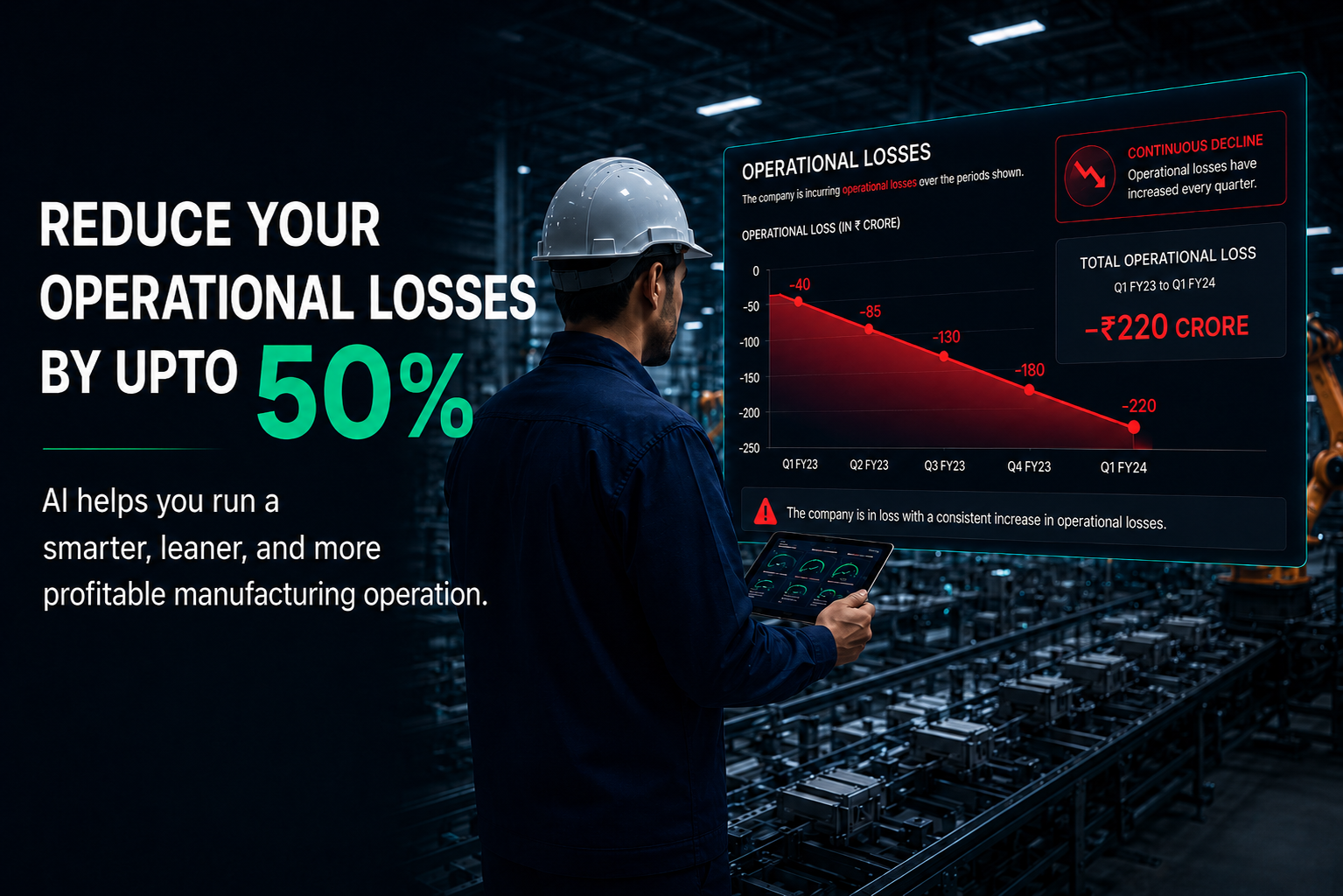
Factory owners, you're bleeding money. You just can't see where.
Let me tell you something most consultants won't.
The biggest threat to your factory isn't a bad quarter, a delayed shipment, or even a broken machine. It's the losses you don't know are happening. The ones that don't show up on any single report. The ones that have been quietly eating your margins for months, maybe years.
I've seen this pattern too many times. A plant looks fine on paper. Output is decent. Orders are going out. And yet, every quarter, the numbers are just a little worse than they should be.
That's not bad luck. That's a visibility problem.
Here's What "invisible loss" actually looks like
Picture this.
A factory owner, let's call him Ramesh, runs a mid-sized auto components unit. By all accounts, things are running. Machines are on. Workers are on the floor. Orders are shipping.
But Ramesh keeps noticing his margins are thinner than last year. And the year before that.
So he does a proper audit. And what he finds surprises him.
One of his CNC machines has been running at 62% efficiency for months, not because it broke down, but because of small, undetected micro-stoppages that nobody flagged.
One of his suppliers has been delivering slightly off-spec raw material that only fails at the assembly stage, so the cost gets absorbed silently.
And he's been sitting on two months' worth of a component that nobody's actually ordering anymore.
Three issues. None of them dramatic. All of them invisible.
Together? Over ₹18 lakhs a month, gone.
There was no big disaster. Just small leaks, every single day.
The problem isn't your people. It's what they can't see.
Your floor managers are doing their jobs. Your supervisors are doing rounds. Your team is working.
But no human being no matter how experienced can simultaneously watch machine health, inventory movement, vendor performance, quality trends, workforce efficiency, and market signals.
Not in real time. Not across an entire plant.
That's not a failure of effort. It's just a physical impossibility.
And that's exactly the gap VISTAAR AI was built to close.
What VISTAAR AI actually does
It watches everything, all at once, so problems get caught before they become losses.
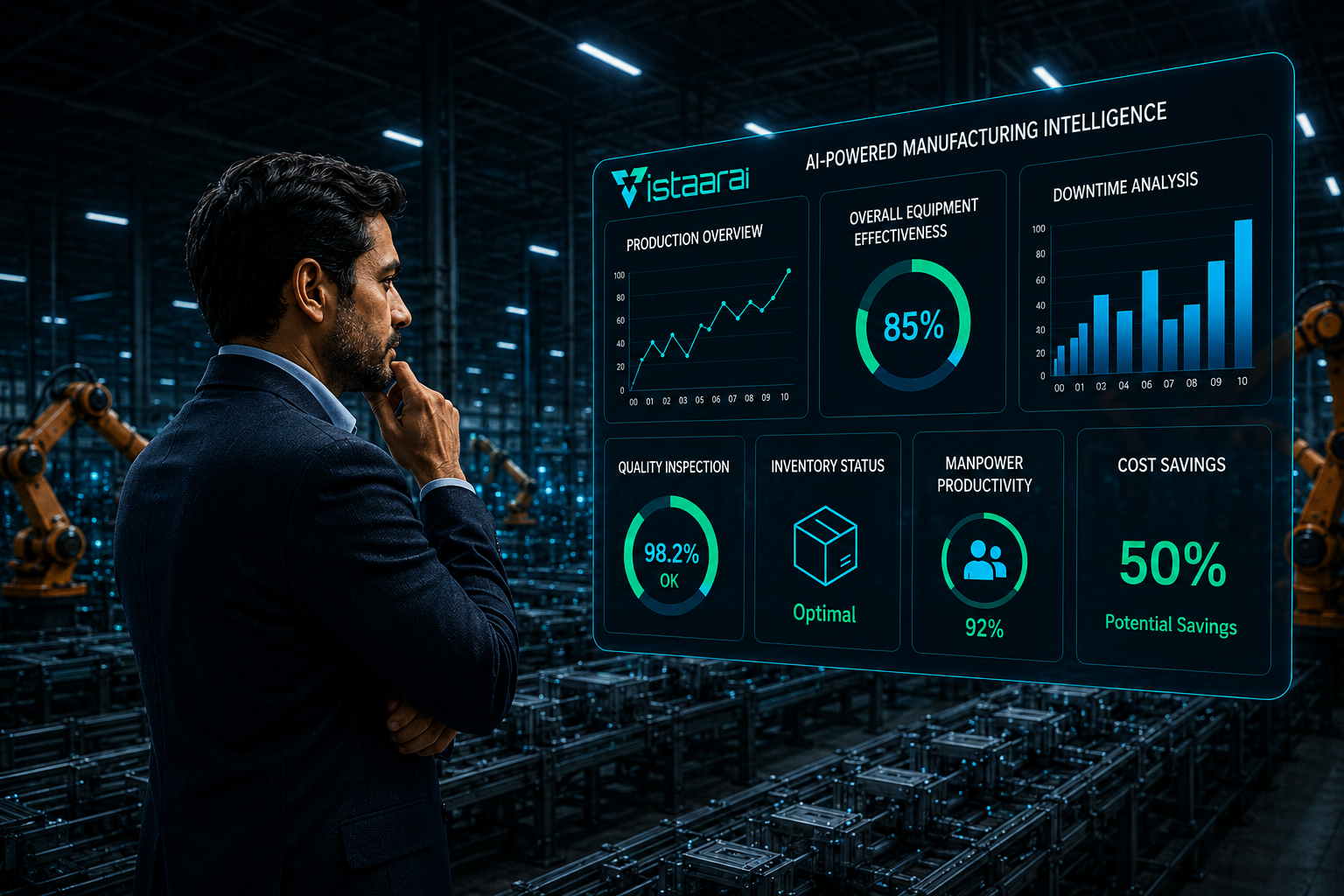
- Manpower: who's productive, where the slowdowns are, and what the floor actually looks like versus what you think it looks like.
- Inventory: what's moving, what's stuck, and what's silently tying up your working capital.
- Machines: efficiency, downtime patterns, and early signs of degradation.
- Quality: catching defects before they reach the customer.
- Vendors: identifying suppliers that are quietly increasing operational costs.
- Market Intelligence: demand shifts, raw material prices, and supply chain signals.
All of it. One place. Real time.
Why "real time" matters more than you think
Here's the thing about factory losses they compound.
A 3% efficiency drop on one machine leads to a slightly delayed batch. That delayed batch pushes a delivery. That delayed delivery triggers a penalty clause. And that penalty hits your cash flow at exactly the wrong time.
What started as a maintenance issue becomes a financial problem. And by the time it shows up in your monthly report, the damage is done.
VISTAAR AI breaks that chain at the first link. Not because it's magic but because it catches the 3% drop the moment it happens, not three weeks later.
So what does 50% reduction in operational losses actually look like?
It's not one big fix. It's a hundred small ones.
It's catching a machine running inefficiently on day two instead of month two. It's knowing a vendor's quality has slipped before it affects your production line. It's seeing that a particular SKU has been overstocked for six weeks before you reorder it again.
None of these feel like big wins in the moment. Together, they change your margins completely.
If you've read this far, you already know something's off.
Most factory owners who find their way to VISTAAR AI aren't in crisis. They're simply aware that their numbers should be better than they are and want to understand why.
If that's you, let's talk.
No pitch. No pressure. Just a look at where your losses might actually be hiding.